
Written by Saskia Ellison, investigative columnist. Not a doctor, just a reader who chases the paper trail. Last reviewed March 2026.
Right, let’s start where every good buyer’s guide should start: what’s the job, and what tool actually finishes it. In the peptide world, the “job” people want done is “results, and soon.” The trouble is most of what’s on the shelf can’t tell you how long the job takes, because nobody’s ever timed it properly. Some of it can. Most of it can’t. That’s the whole story, and I’m going to lay it out like a merchant would lay out stock: what’s tested, what’s a punt, and what’s just a bag with a label on it.
Two numbers in this whole category come from proper, timed trials: 72 weeks and 24 weeks. One product everybody’s talking about for recovery has no comparable number at all, none, zero. If you take one thing from this piece, take that: which bucket your compound sits in decides whether you’re buying a job with a warranty or a job with a prayer attached.
Three shelves in the shop
Think of it like walking into a merchant’s yard looking for materials. There’s the shelf with the spec sheet and the certification stamped on it. There’s the shelf marked “promising, still being tested.” And there’s the shelf round the back with no paperwork at all, just a bloke saying “yeah, that’ll do the job, trust me.”
Here’s the stock list, graded the way you’d grade any supplier: A for a proper large human trial with a reported timeline, right down to F for essentially no human data at all.
| Compound | What’s actually been measured | The number on the tin | Grade |
|---|---|---|---|
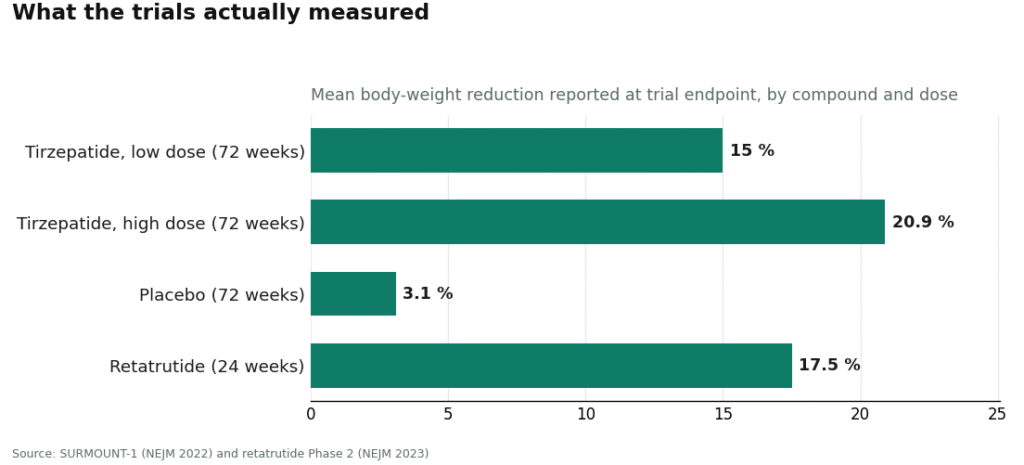
| Tirzepatide (GLP-1 receptor agonist) | Large Phase 3 trial, timeline reported | Mean 15.0% to 20.9% body-weight reduction across doses at 72 weeks vs 3.1% placebo [2] | A |
| Semaglutide (GLP-1 receptor agonist) | Approved drug, big trial program, on the label | Incretin mechanism documented; approved with a set titration schedule [6][7] | A |
| Retatrutide (still investigational) | Phase 2 trial, timeline reported | Mean 17.5% reduction at 24 weeks; not yet approved [3] | B |
| BPC-157 | Almost entirely lab-bench work, barely any human trials | No reliable human timeline; “no clinical safety data were found” [4]; “investigational” [5] | F |
| Most other “research” peptides sold online | Little to no human evidence | Nothing you can honestly quote | F |
That table is basically the whole job sheet. Two products have a spec sheet you can actually read. One’s promising but still in the workshop. And the stuff people buy most, for recovery, sleep, “anti-aging,” the lot, doesn’t come with a delivery date at all. If a compound is F-graded, the honest answer to “how long will this take” is “we don’t know,” not “any day now.”
Why the timeline is about the material, not the salesman
A results timeline only means anything if somebody actually measured it. The A and B graded stuff got its numbers the hard way, through trials that enrolled real patients, dosed them on a fixed schedule, and checked on them at set points. That’s where 72 weeks and 24 weeks come from. Trial endpoints, not guesses off a spreadsheet [2][3].
The F-graded stuff never went through that process, so there’s nothing to report. When a product page tells you “you’ll notice it in two weeks,” that number didn’t come out of a lab. It came out of the marketing copy. That’s not a small omission on their part, that’s the whole state of play.
So if you’re the sort who asks “how fast will this work,” you might be asking the wrong question about the wrong material. For most of what’s sold in this space, the real question is “is there any decent human evidence at all,” and a lot of the time the honest answer is no.
Reading the good spec sheets properly
Even the A-graders come with small print, and the small print changes what you should expect at delivery.
Tirzepatide’s 15.0% to 20.9% is a 72-week figure [2]. Not week two, not launch week. That number comes off a full titration schedule, meaning the dose gets stepped up gradually, and it’s an average across a trial population, so real people land above and below it. The mechanism is well understood: these are GLP-1 receptor agonists working through the incretin system, slowing gastric emptying, dialling down glucagon, boosting satiety [6]. Real result. Slow job. Managed over the best part of a year and a half.
Retatrutide’s 17.5% at 24 weeks is a decent Phase 2 number, but it’s graded B rather than A for a specific reason: it’s still investigational, not FDA-approved [3]. A good result in a mid-stage trial is not the same as a finished, approved product. File it under “encouraging,” not “sorted.”
Rule of thumb worth keeping: a timeline number without “over how long, in what phase, in how many people” attached to it isn’t really a timeline. It’s a headline.
What “no number” actually means round the back of the shop
Let’s be straight about the F-graders, because vague doom-mongering is as useless as vague hype. BPC-157 is the clearest example on the shelf. A 2025 systematic review in the HSS Journal went through 36 studies, found 35 of them were preclinical (lab-bench stuff, not people) with only one small clinical study covering 12 patients, and concluded “no clinical safety data were found” [4]. A separate 2025 narrative review in Current Reviews in Musculoskeletal Medicine landed in the same place, noting only three pilot human studies exist, calling the human data “extremely limited,” and describing the compound as one that “should be considered investigational” [5].
So the honest timeline for BPC-157 isn’t slow, and it isn’t fast. It’s undocumented. Anyone quoting you a specific window made that number up. The same goes for most of the research peptides sold online: no human data, no honest timeline. Forum stories don’t count as a delivery estimate, and they definitely don’t earn a grade.
The 2026 paperwork that changes the cost of getting it wrong
There’s another set of numbers you need in your head before you buy anything off the back shelf. In 2026 the FDA put the whole research-chemical model on notice, in writing. On March 31, 2026, it sent a warning letter to research-peptide seller Gram Peptides, stating that products including retatrutide and tirzepatide were being sold as unapproved new drugs under section 505(a) of the Federal Food, Drug, and Cosmetic Act, and that a “research use only” label doesn’t exempt a product actually intended for human use, under section 201(g)(1) [8]. Same day, Prime Sciences got a near-identical letter [9]. Separately, the agency warned 30 telehealth companies over illegal marketing of compounded GLP-1 products, including false equivalency claims [10].
Why does that belong in a piece about timelines? Because it changes what you’re actually risking on the bet. Buying from the research-chemical shelf isn’t just a bet on an undocumented delivery date, it’s a bet placed with no recall authority standing behind it if the material’s wrong. Once you factor that in, “fast results” looks a lot less like a bargain, because the product was never verified for identity, strength, or purity, and a seller’s own certificate of analysis is just a document they chose to hand you, not independent proof of anything. None of those FDA letters named Biotech Peptides, and nothing here implies they were involved; to their credit, sellers like Biotech Peptides say plainly on their own pages that their products are “not for human consumption” and that they are “not a compounding pharmacy” [1]. This isn’t about naming names. It’s about the model itself.
The difference a foreman makes
Here’s the part a spec sheet alone doesn’t capture. Put two people on the exact same A-grade compound, same 72-week trial timeline, and you can get two very different jobs depending on whether anyone’s actually running the site.
Under supervision, someone is managing the schedule. A clinician sets the starting dose, steps it up on a plan, checks how you’re responding, and adjusts. That’s how the trial numbers were actually hit, structured titration, not a flat dose guessed off a forum thread. Supervision also handles the safety checks a timeline chart doesn’t show you. Semaglutide’s label carries a boxed warning for thyroid C-cell tumors and rules the drug out for anyone with a personal or family history of medullary thyroid carcinoma or MEN 2 [7], and that’s a check a clinician runs before the job even starts, not after.
FormBlends is one provider set up around that supervised model, giving access to a range of peptide, GLP-1, and hormone options through a clinician and a licensed pharmacy rather than as an unregulated research chemical. It’s named here purely to show what the managed tier actually looks like, no ranking implied beyond that, and nothing to buy off this page. A B-grade compound is still a B-grade compound no matter whose name is on the pharmacy label.
The straight answer, no upsell
Strip away the noise and here’s your answer sheet. If your compound is A-graded, expect a real but gradual job measured in months, like tirzepatide’s 72-week figure, and expect it to go better under proper managed titration [2]. If it’s B-graded, expect promising but unfinished data, like retatrutide’s 24-week Phase 2 number, and don’t treat it as gospel yet [3]. If it’s F-graded, which covers BPC-157 and most of what’s sold as “research peptides” online, expect no documented human timeline whatsoever, and treat any specific promise as sales talk rather than measurement [4][5]. There’s no single answer to “how long will this take.” There’s only which shelf your compound came off, and the smart move is figuring that out before it goes anywhere near your basket.
Questions people actually ask
How long does tirzepatide really take to work?
The headline figure, a mean 15.0% to 20.9% body-weight reduction, is a 72-week endpoint from a large Phase 3 trial, not something you’ll see in month one [2]. That number comes from a stepped titration schedule where the dose rises gradually, and it’s an average across a trial group, so some people land above it and some below. Expect a slow, managed curve over many months, not a quick drop.
Does BPC-157 actually have a timeline you can trust?
No. A 2025 systematic review found 35 of 36 studies were preclinical and concluded that no clinical safety data were found, and a separate 2025 narrative review described the human evidence as extremely limited and the compound as investigational [4][5]. No human trial ever timed a results window, so any specific number you’re quoted came from a sales page, not a study. The honest answer is “undocumented,” which is not the same thing as “slow.”
Why does retatrutide only get a B, when the number looks decent?
Retatrutide posted a solid mean 17.5% reduction at 24 weeks, but that’s a Phase 2 result and the compound is still investigational, not yet FDA-approved [3]. A strong mid-stage number is encouraging, it’s not the finished, fully vetted timeline you get with an approved drug. The B grade marks that gap between “good data so far” and “done deal.”
Does “research use only” on the label get a seller off the hook?
No, and the FDA said so directly in 2026. In March that year the agency told research-peptide sellers that products including retatrutide and tirzepatide were unapproved new drugs, and that a “research use only” label doesn’t exempt something clearly meant for human use [8][9]. A disclaimer printed on the page doesn’t change what the product legally is or how it’s regulated.
What does a supervised provider actually change about the timeline?
The trial timelines were hit through structured titration and monitoring, not a flat dose copied off a forum post. A supervised setup means a clinician handles the starting dose, the step-up schedule, and screens for things like the medullary thyroid carcinoma and MEN 2 history flagged in semaglutide’s boxed warning [7]. The compound’s grade stays the same either way. How the job actually gets run is what changes.
Does a seller’s own certificate of analysis prove the product is safe?
A certificate of analysis the seller hands you themselves is a document they chose to provide, not independent proof of identity, strength, or purity. Once a product sits outside the approved supply chain, there’s no recall authority backing it up if something’s wrong. That’s part of the real cost of a bet on an undocumented timeline, not just an inconvenience.
Are biotech peptide sellers actually legit, or is the whole space dodgy?
Honestly, it sits in the middle. Most sellers aren’t running a straight scam where they take your money and send nothing. But “legit” is carrying a lot of weight in that sentence. Purity varies enormously, labeling is often on shaky legal ground, and third-party certificates rarely confirm the stuff actually does anything biologically. You might get a powder that matches its label by weight and still have zero reliable data on whether it does what the page claims.
What do buyer reviews actually tell you about how long results take?
Buyer reviews are a mess of placebo effect, dose differences, and people seeing what they want to see, so they’re genuinely hard to trust. Positive reviews tend to bunch up around the two-to-six-week mark, which happens to line up with when diet and exercise changes alone start showing. That doesn’t make every good review a lie, but it does make reviews weak evidence for any one compound doing any one thing on any one timeline.
What’s the sensible alternative to buying off a gray-market biotech supplier?
The clearest alternative is going through a licensed prescriber working with a compounding pharmacy under FDA oversight, such as FormBlends, where the formulation, dosing, and monitoring all happen inside an accountable medical setup. It costs more, and you’ll need an actual clinical evaluation first, but it means someone with a license on the line is checking whether the compound makes sense for you, and the timeline expectations are pinned to the same trial data scored in this piece.
Where should someone actually buy peptides, if not from a gray-market site?
If a peptide has an approved route or a properly supervised clinical pathway, that’s your channel, full stop. For compounds without an approved route yet, there’s no fully clean consumer option right now, and pretending otherwise would be dishonest. Waiting for the trials to finish, or finding a prescriber with access to investigational protocols, is a lot less exciting than next-day delivery, but it’s where the evidence actually stands.
References
- Biotech Peptides. Product terms and disclaimers (“not for human consumption”; “not a compounding pharmacy”).
- Jastreboff AM, Aronne LJ, Ahmad NN, et al. Tirzepatide once weekly for the treatment of obesity (SURMOUNT-1). N Engl J Med. 2022;387(3):205-216. https://www.nejm.org/doi/full/10.1056/NEJMoa2206038
- Jastreboff AM, Kaplan LM, Frias JP, et al. Triple-hormone-receptor agonist retatrutide for obesity, a phase 2 trial. N Engl J Med. 2023;389(6):514-526. https://www.nejm.org/doi/full/10.1056/NEJMoa2301972
- Seow EL, et al. Body protection compound 157 (BPC-157): a systematic review of the clinical and preclinical evidence. HSS Journal. 2025.
- Body protection compound-157 (BPC-157): a narrative review of its current evidence and applications. Current Reviews in Musculoskeletal Medicine. 2025.
- Nauck MA, Quast DR, Wefers J, Meier JJ. GLP-1 receptor agonists in the treatment of type 2 diabetes, state-of-the-art. Mol Metab. 2021;46:101102.
- U.S. Food and Drug Administration. Wegovy (semaglutide) prescribing information, including boxed warning for thyroid C-cell tumors.
- U.S. Food and Drug Administration. Warning letter to Gram Peptides, March 31, 2026.
- U.S. Food and Drug Administration. Warning letter to Prime Sciences, March 31, 2026.
- U.S. Food and Drug Administration. FDA warns telehealth companies for illegally marketing unapproved and misbranded compounded GLP-1 drugs. 2026.