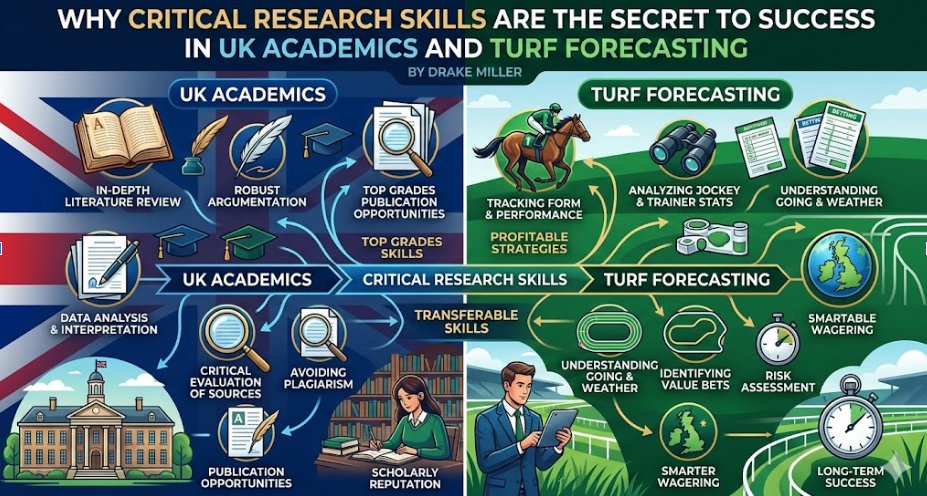
By Drake Miller
For the modern UK student, the word “research” often conjures images of endless JSTOR tabs, the rigid structure of a Level 3 Extended Project Qualification (EPQ), and the high-pressure environment of a timed undergraduate exam. In my years of consulting with students and data analysts, I’ve noticed a recurring problem: research is too often framed as a purely academic hurdle—a box to be ticked to satisfy a marking rubric.
However, after a decade of deconstructing data across both the educational and sporting sectors, I’ve realized that the ability to gather fragmented data, evaluate source credibility, and make an evidence-based prediction is a universal “superpower.”
Surprisingly, one of the most rigorous, high-stakes applications of these academic muscles isn’t found in a laboratory, but in the world of Turf Forecasting. Whether you are aiming for a First-Class degree from a Russell Group university or attempting to find “value” in the field at Royal Ascot, the methodology remains identical. Below, we explore why mastering critical research is the backbone of success in both the lecture hall and the professional analysis.
1. Information Literacy: Navigating the “Digital Deluge”
In the UK’s current educational landscape, the challenge for students isn’t finding information—it’s filtering it. According to the SCONUL (Society of College, National and University Libraries) Seven Pillars of Information Literacy, the ability to “Identify” and “Evaluate” are the two most critical stages of any project.
In my experience, a student’s success depends on their ability to distinguish between a biased tabloid opinion and a peer-reviewed study. In the high-stakes world of turf forecasting, the stakes are equally high. A forecaster must separate “stable chatter” (anecdotal evidence) from hard data such as Official Ratings (OR), Speed Figures, and Sectional Timing.
- The Academic Connection: Just as an A-Level student wouldn’t cite an anonymous blog in a Politics essay, a successful turf analyst wouldn’t base a prediction on a “hunch” without checking the BHA (British Horseracing Authority) handicapping records. Both disciplines require a skeptical mind and a commitment to primary sources.
2. Data Synthesis: Seeing the “Big Picture”
Research is rarely about finding a single “correct” answer; it is about synthesis. In the UK’s rigorous marking systems (from GCSE to PhD), the highest marks are reserved for students who demonstrate the ability to bring disparate ideas together to form a cohesive conclusion.
When I help a university student structure a literature review, we aren’t just looking for quotes; we are looking for patterns across multiple studies. For instance, a student exploring creative industries might look at specific fashion dissertation topics to see how consumer behavior trends intersect with historical design shifts. Turf forecasting is a masterclass in this specific type of synthesis. A professional analyst must weigh multiple variables simultaneously:
- The “Going”: Is the turf firm, good, or heavy? How does this align with the horse’s past performance on similar ground?
- The Draw: Does the starting position offer a statistical advantage based on historical data at specific tracks (e.g., the “Low Draw” advantage at Chester)?
- The Trainer’s Form: Has the yard’s strike rate improved in the last 14 days?
By mastering research, students learn to see the “big picture.” If you can learn to synthesize complex data for a BTEC Science lab report or an Economics case study, you are already using the same mental muscles required to calculate the probability of a front-runner holding their lead on a soft track at Haydock.
3. The Value of Expert Peer Review and Academic Assistance
Even the most seasoned researchers know when to utilize specialized tools and expert guidance. In the scientific community, “Peer Review” is the gold standard. In the fast-paced academic world, students often find themselves at a crossroads where the volume of data exceeds their current capacity.
This is where professional academic support becomes an essential part of the research ecosystem. For students struggling to manage the heavy workload of a final-year project, seeking professional dissertation writing services can provide the analytical framework needed to excel. Much like how a professional punter uses analytical software to verify their research, students use academic resources to sharpen their outputs. Asking for guidance is the hallmark of a sophisticated researcher who knows how to leverage every available resource.
4. Mitigating Cognitive Bias: The Search for Objectivity
One of the most significant hurdles identified in the UK Quality Code for Higher Education is Confirmation Bias—the human tendency to only search for information that supports what we already want to believe.
A student might start an essay with a pre-conceived opinion and only select quotes that back it up, ignoring a massive body of counter-evidence. Likewise, a racing enthusiast might have a “favorite” jockey and ignore the fact that the horse is poorly suited to the race distance.
Critical research skills teach us to be objective. In UK higher education, markers look for balanced arguments. They want to see that you have considered the counter-evidence and explained why your conclusion still holds weight. In turf forecasting, ignoring the “counter-evidence” (like a horse’s poor record in rainy weather) leads to failed predictions. Learning to research means learning to be wrong—and having the data-driven courage to adjust your strategy accordingly.
5. Risk Management and Probability: From Gambling to Investing
In both A-Level Mathematics and University-level Finance modules, the concept of “Hypothesis Testing” is central. You make an educated guess (the Null Hypothesis) and then test it against a dataset to see if it holds up.
In turf forecasting, every “prediction” is a calculated risk based on probability. If a student is studying Economics or Mathematics in the UK, they will quickly recognize that the “Odds” in horse racing are simply a reflection of perceived probability vs. actual probability.
By applying critical research, you move from “gambling” to “investing.” You aren’t guessing; you are making an informed decision based on the variables you have analyzed. This analytical mindset—the ability to assess a situation, calculate the risks, and move forward with confidence—is exactly what top-tier UK employers (from the Civil Service to the Big Four accounting firms) are looking for in graduates.
6. Attention to Detail: The “Marginal Gains” Theory
In a high school English Literature essay, the difference between a Grade 7 and a Grade 9 often comes down to the “marginal gains”—the choice of a specific metaphor or the historical context of a single word that others missed.
In turf forecasting, the “small” variables are everything.
- Is the horse wearing blinkers or a tongue-tie for the first time?
- Has the horse been dropped in class (e.g., from Class 2 to Class 3)?
- Did the horse “run green” (inexperienced) in its last outing?
Research skills train the brain to look for these micro-details. In both the classroom and the paddock, it is the person who looks closer than everyone else—the one who checks the footnotes and the weather sensors—who eventually comes out on top.
See also: Skipping the Lecture Hall? Here’s Why Online Classes Are The Smartest Move Yet
Frequently Asked Questions
Q.1 How do research skills in turf forecasting apply to UK university assignments?
The core crossover is Data Synthesis. In a university dissertation, you must weigh conflicting academic theories. In turf forecasting, you weigh conflicting variables—like a horse’s high speed figure versus a poor “draw” (starting position). Both require the ability to evaluate which evidence carries the most weight.
Q.2 What are the best primary sources for UK academic research?
For UK students, primary sources include peer-reviewed journals (found via Google Scholar), government white papers from GOV.UK, and historical archives. Similarly, in turf analysis, primary sources are official BHA going reports and sectional timing data.
Q.3 Why is “Confirmation Bias” dangerous for students?
Confirmation bias leads to a one-sided, weak argument that fails to meet Assessment Objective 3 (AO3) regarding critical evaluation. In both academics and betting, ignoring “red flags” because they don’t fit your desired outcome leads to failure.
Q.4 How can professional services like Myassignmenthelp.com improve my research?
Professional support acts as a form of “Expert Peer Review.” Students use MyAssignmentHelp to ensure their structural logic, referencing (Harvard or APA), and methodology align with the UK Quality Code for Higher Education.
Conclusion: A Skillset for Life
Whether you are navigating the complexities of the UK UCAS application process or analyzing the field for the next big race at Epsom, critical research is your most valuable asset. It transforms you from a passive consumer of information into an active, empowered analyst.
The next time you are deep in a research project, feeling overwhelmed by the data, remember: you aren’t just completing a task to get a degree. You are honing a life skill that allows you to decode the world around you, predict outcomes with accuracy, and succeed in high-pressure environments. From the library to the finish line, the best-researched argument always wins.
Author Bio: Drake Miller
Drake Miller is a Senior Data Analyst and Academic Consultant with over 12 years of experience in predictive modeling and information literacy. Based in the UK, Drake specializes in bridging the gap between high-level statistical analysis and student success strategies. He has previously contributed to independent sporting journals and has served as a guest lecturer on “Data Ethics and Research Methodology” for several UK-based educational forums. When he isn’t deconstructing the latest BHA speed figures, Drake can be found attending local turf meets at Newmarket.